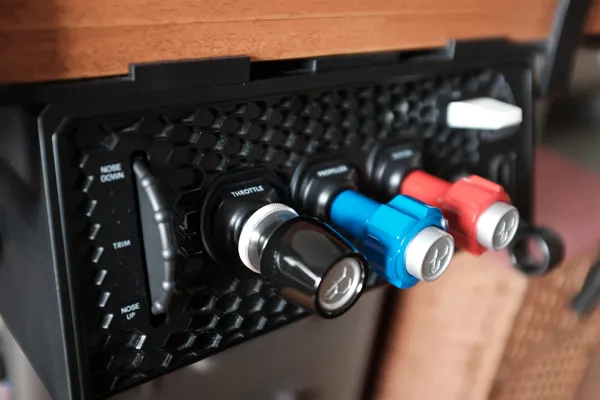
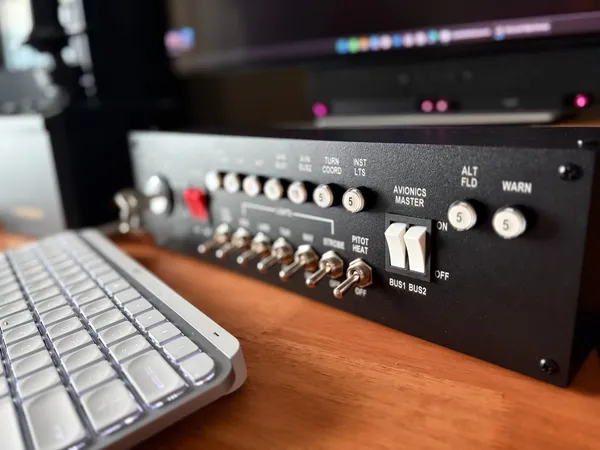
Who owns the home sim cockpit in 2026? The flight sim hardware market, from boxes to systems
The first honest strategy view of the consumer flight sim hardware market — sized at US$150-500M, mapped across six strategic groups, and built on twelve hands-on reviews. Value is moving from boxes to systems; here's who wins.
The answer to the title question: nobody yet — and that's the opportunity.
This report is built from two things most market analyses of this industry don't have: the largest community dataset in flight sim (the 2026 Navigraph survey) and hands-on testing of twelve products across ten brands under Magenta Debrief's public review rubric. The analysis and the evidence are in the same document.
For two decades, the flight sim hardware market ran on boxes. A yoke here, a throttle there, a switch panel from a third vendor, each with its own USB cable, its own software, its own mounting holes. Buyers assembled cockpits from a dozen brands and accepted the friction as the price of the hobby.
That era is ending. Value in flight simulation is migrating from individual hardware to integrated systems, and the next winners won't be the best hardware makers. They'll be whoever owns the layer that makes everyone's boxes work together — or locks them in.
Three findings
1. The market is real, fragmented, and at an inflection. Consumer sim hardware — distinct from the US$6-18B professional training market that dominates existing research — is growing with MSFS 2024 adoption (49.5% of simmers, up from 24.9%), home cockpit builds (10.3%, up from 9.2%), and a hardware-spend shift toward incremental, modular upgrades. We broke down the community survey separately if you want the full picture of who simmers are.
2. Value is migrating from boxes to the integration layer. The profitable layers of flight sim are already elsewhere: aircraft addons and data subscriptions. Hardware is where margins are structurally thinnest and competition is most crowded. The unclaimed value pool is the layer that connects boxes — mounting standards, hubs, configuration software.
3. No player owns the full integration layer, and open is the only winnable play for most. Mounting is partially standardized by the community, but the software and hub layers are unclaimed. The market is too small for a standards war. The winners will be those who define the standard others build to, or own the full stack. For most players, open is the only path with a real chance.
The implications differ by player type. Incumbents: your brand won't save you from the ecosystem shift. Ecosystem builders: pick open vs closed deliberately, because the software layer is where it's won or lost. New entrants: the GA modular whitespace is real but no longer empty — Meridian GMT's Latitude Plus ships a GA control set from December 28, 2026, and the unclaimed prize is the identity of GA-first open modular. And the glue layer: the configuration software no one has built well is the biggest open opportunity in the market.
Market definition and sizing
What this market is, and isn't
Every existing flight simulator market report covers the professional training market: CAE, Thales, L3Harris, FlightSafety, the US$6-18B world of full-flight simulators that airlines and militaries buy. This report covers the market those reports ignore: consumer flight sim hardware. Yokes, sticks, throttles, quadrants, pedals, panels, trim devices, mounts, and home cockpit components, bought by individual simmers and cockpit builders.
The two markets share the phrase "flight simulator" and almost nothing else. Different buyers, different price points, different distribution, different decision logic. A pilot training on a CAE full-flight sim is not a prospect for a Honeycomb Alpha yoke.
Sizing: a bottom-up estimate
We size the market from ownership data rather than top-down revenue claims. The Navigraph survey — the largest of its kind, with 15,600 clean respondents — provides ownership rates for the enthusiast core:
- Throttle quadrants: 64.9% of simmers own one — the most common peripheral
- Joysticks: 63.4%
- Rudder pedals: 59.3%
- HOTAS: 28.2%
- Homebuilt cockpit projects: 10.3% and rising
The enthusiast core is the hardware-buying population. The addressable market:
- 1-2 million active simmers own at least one piece of dedicated hardware (MSFS 2020 and 2024 have drawn 12-15M players total since launch; the monthly active base is estimated in the low millions across PC, Xbox, and PS5; the hardware-owning core sits below that)
- Hardware spend concentrates in the US$100-300 band, with 10.4% of simmers spending US$1,800 or more in a year
Market size: roughly US$150-500 million annually, triangulated from two independent derivations:
- Bottom-up, from Amazon review velocity. The five best-selling volume SKUs — Logitech X56 (2,933 reviews), Turtle Beach VelocityOne (2,485), Thrustmaster T.16000M (2,341), Honeycomb Alpha (1,198), Thrustmaster TCA (928) — represent roughly 330k-990k lifetime units on Amazon alone at the standard 1-3% review-to-unit ratio. Scaled for the non-Amazon channel and annualized over their 5-10 year lifecycles, those five products alone imply US$15-90M a year. They are perhaps a quarter of the market by value, which lands the full market at US$40-450M
- Top-down, from population and spend. 1-2M hardware owners at a US$250-400 average annual spend implies US$250-800M. The two methods bracket each other; the overlap is the credible band
The swing factor: the 10.4% of simmers spending US$1,800+ a year. If that tier grows — with force feedback entering at US$700-1,000 and home cockpit builds rising — the market moves toward the upper bound. That's the direction it's already pointing.
The range matters less than the shape: a market large enough to sustain a dozen specialized vendors, small enough that no single player can dominate it by capital alone, and fragmented enough that the integration layer remains unclaimed.
Growth drivers
- MSFS 2024 is consolidating the platform. It holds 49.5% primary share, up from 24.9%, and 45.2% of simmers switched platforms in the past year, mostly toward it. A consolidating platform concentrates buyers and makes hardware standardization more valuable
- The training pipeline is a durable buyer. 20.9% of simmers hold a pilot license, 8.9% are enrolled in flight school, and 21.3% are considering lessons. These are buyers with a real-world reason to own GA-specific hardware — the same reason we wrote how to build a home flight sim rig for pilot training
- Home cockpits are growing. Homebuilt projects rose from 9.2% to 10.3% year over year, and DIY builds climbed from 5.9% to 7.8% of planned purchases
Value pool analysis: where the money actually is
The finding that surprises hardware vendors: the money in flight sim isn't mostly in hardware.
The value pools, in order of margin:
- Aircraft addons. Fenix's Airbus family is flown by 42.4% of MSFS simmers; PMDG's 737 by 31.5%. These are licensed-content businesses with software margins at a US$60-90 price point — the app-store economics of flight sim, applied to aircraft
- Data and subscriptions. Navigraph Charts (74.1% usage) and SimBrief (75.3%) run on recurring revenue — the only true annuity in the ecosystem
- Hardware. Structurally the thinnest margins: Amazon takes its cut, Chinese OEM competition compresses pricing, and discovery depends on reviews. Hardware is where most new entrants go and where value is hardest to hold
- Distribution. The marketplace is the retail layer
The structural insight: the profitable layers are owned by companies that don't make hardware at all. The integration layer — mounting, hubs, configuration software — is the major value pool that sits between hardware and software, and it's being claimed piecemeal by software players. The AI-ATC category shows the pattern: SayIntentions.AI (14.4% of simmers, up from 9.7%) now drives the Elgato Stream Deck natively — push-to-talk, intercom, co-pilot, volume, a live COM radio panel — putting physical controls in front of pilots without building a single box, and BeyondATC (27.8%, the larger player) is integrating live traffic with Navigraph into the same stack. Neither makes hardware. The software players captured the integration premium first.
The market is saying this directly. In the Navigraph survey, the hardware-spend trend is that large purchases are slowing in favor of incremental, modular upgrades. The top planned purchase is avionics hardware (22%) — modular panels, not another box.
The strategic groups table
Group the market by two dimensions: integration depth (standalone box to full ecosystem) and market focus (GA to airliner to multi-segment).
| Group | Players | Position |
|---|---|---|
| Incumbents | Thrustmaster, Logitech, Turtle Beach, Honeycomb | Boxes at scale; brand and distribution, no ecosystem |
| Ecosystem builders | Winwing/WinCTRL, Wingflex, MOZA, Meridian GMT | Building modular lines; MOZA porting its racing closed-ecosystem playbook; Meridian executing the most complete modular platform yet — interchangeable yoke heads, GA/Airbus/Boeing control sets on one platform |
| GA modular specialists | Octavi, PU Air, Desktop Pilot | Individual GA modules at mid price; Octavi and PU Air panels, Desktop Pilot's TPM throttle — the nascent GA modular tier |
| Cockpit platforms | Next Level Racing, DOF Reality | The physical-side ecosystem play: Boeing-licensed cockpit frames and motion platforms that package the whole rig as one system |
| Premium niche | Virpil, VKB, Brunner, RealSimGear | High fidelity, high price; combat-oriented sticks; RealSimGear's Cirrus side-stick replica at US$1,599 |
| Price entrants | Meza, Amazon generics | Individual modules at low price; no brand, no website, no ecosystem |
What the grouping shows:
The deep-integration, GA-focused position — the top of the GA column — is still unclaimed. No player has built a GA-first open modular ecosystem as an identity. But the pure product space is no longer empty: Meridian GMT's Latitude Plus ships a complete GA control set — trim wheel, gear lever, parking brake, avionics controls — from December 28, 2026, on a base that takes Airbus and Boeing modules later. That's an entering wedge from the ecosystem-builder side.
Airbus modular is crowded: Winwing's FCU/EFIS, Wingflex's CUBE series and GMP, Thrustmaster's TCA, Skalarki at the high end. The incumbents are the most exposed: Honeycomb owns GA yokes but has no modular panel play, and the ecosystem builders are coming from underneath.
The grouping explains two things at once: why a price entrant like Meza exists (real whitespace, low barriers), and why it can't afford to stay a box-maker (the ecosystem builders are defining the category, and the GA product space now has a funded entrant).
Industry structure
Five forces, lightly applied — enough to explain why the market looks the way it does.
- Supplier power: low. Chinese OEM manufacturing means anyone can source hardware. No player owns a critical input; the wave of Chinese brands — MOZA, Winwing, Wingflex, Meza — is the proof
- Buyer power: high. Amazon plus review-driven discovery means low switching costs. Buyers compare by price and review score, not brand loyalty
- Threat of entry: low to list, high to brand. Anyone can list on Amazon — Meza's desk mount (353 reviews) proves it. Almost no one can build a brand that survives the ecosystem shift
- Substitutes: the DIY and 3D-print layer. MonsterTech's 55+ mounting plates, open-source panel projects, 3D-printed adapters. The community builds what vendors don't sell. This layer is both a substitute and a proto-standard
- Rivalry: intensifying unevenly. Crowded in airliner panels. GA modular was empty and is now being entered from two sides — Meridian GMT's GA set from the ecosystem-builder side, Meza-class entrants from the price side. The next battle is the integration layer
The structure rewards whoever builds brand and ecosystem before the window closes, and punishes pure box-makers. The market's own friction — mounting, software, USB sprawl — is the opportunity.
The ecosystem battleground
The problem state
Every box is its own USB connection, its own software, its own mount. Users assemble cockpits from a dozen vendors with no shared architecture. This is the market's biggest unsolved problem, and its biggest opportunity.
The three plays
- The standard-setter (open). Define the mount, bus, or connector spec, license it, let everyone build to it. Requires critical mass — hard for a single small player, which is why no one has done it
- The full-stack player (closed). Own the mount, the bus, the software, and the module line, and capture the integration premium. MOZA is the one to watch — it ran this playbook in sim racing and is porting it to flight
- The glue layer (software). Own the configuration software that binds all hardware together. The demand is proven and the tools are clunky at the same time: SPAD.next, MobiFlight, FSUIPC, Axis and Ohs — a library of enthusiast tools that pilots depend on and complain about in equal measure. No one has professionalized the configurator, but the claim is being staked from several directions at once. Air Manager turned any touchscreen into a commercial instrument-panel system years ago. SayIntentions.AI now drives the Elgato Stream Deck natively — push-to-talk, intercom, a live COM radio panel — without building hardware of its own. WebFMC puts a full FMC on any tablet through a browser. Third-party profile sellers (Flight Panels) commercialize the same surfaces. The pattern is unmistakable: general-purpose hardware — button grids, touchscreens, tablets — personalized by software. That's the route the glue layer is arriving through, and every current arrival is clunky enough that none of them has closed the deal
The tell cuts both ways: when VIRPIL entered force feedback this year, it brought in the FFBeast team to write the software — the best hardware maker in the market needed an outsider for the glue layer. And the software makers are ahead of the hardware makers, integrating onto platforms they don't own.
The mounting standard as the existing beachhead
Mounting is the one layer that already got standardized — by the community, not by a vendor. MonsterTech's 55+ product-specific mounting plates on one aluminum extrusion mount, plus the 3D-print ecosystem around it, is a de facto standard. Thrustmaster's base plate is the closest thing to a cross-brand convention. Even Meza's US$99.99 desk mount fits Warthog, Orion 2, WarBRD-D, and MongoosT-50CM bases. The standard exists; nobody has claimed it.
The market is too small for a standards war
Apple vs Android happened over a billion-user market. Flight sim hardware is a niche of hundreds of thousands. There is room for one default standard, not two, so the winner isn't the best architecture — it's the easiest to adopt. VHS, not Betamax. The player who wins is the one whose ecosystem is easiest to buy into piece by piece.
Strategic options by archetype
| Archetype | The move | The trade-off |
|---|---|---|
| Incumbent (Honeycomb, Thrustmaster) | Embrace modularity before someone defines it without you; open your mount and software | Cannibalize current box sales; risk of slow execution |
| Ecosystem builder (Winwing, Wingflex) | Pick open vs closed deliberately; invest in the software layer | Closed risks isolation; open risks commoditization |
| Full-stack aspirant (MOZA) | Port the racing playbook; the question is whether flight sim is big enough to amortize it | Capital-intensive; the market may be too small |
| New entrant (Meza, generics) | Be the easiest module to say yes to; win the GA-first open-modular identity | Brand-building costs; Amazon dependency |
| Glue-layer player (nobody yet) | Build the configuration software that binds all hardware | Software is hard; the ecosystem must exist first |
For the new entrant specifically:
- Stay GA-focused; design the platform standard — mounting, HID, hub — so airliner modules bolt on later
- Win the category you can own first: GA-first open modular. Move with urgency — Meridian GMT's Latitude Plus ships a GA control set (trim wheel, gear, parking brake) from December 28, 2026. The product space is no longer empty; the identity is still unclaimed, and it goes to whoever builds the coherent story first
- Speed and brand presence are the binding constraints. A new brand with no website and a name nearly identical to a bigger competitor is invisible while the window closes
- The market data supports the thesis — Navigraph's modular-upgrade trend is the entrant's argument. But it's everyone's argument now. Execution timing matters more than insight
Signposts and scenarios
The report ends with what to watch, not what will happen. Five events change the picture:
- Meridian GMT's execution. Pre-orders are open. The Horizon Plus yoke ships October 28, 2026, and the Latitude Plus GA control set — trim wheel, gear lever, parking brake — follows December 28, 2026. Do they hit the dates, and does the GA set land? It's the most complete modular-ecosystem play yet, and its GA set sits directly in the space Meza wants
- The force-feedback cascade. VIRPIL ATLAS (25Nm at US$720, Pro 45Nm at US$890) went to pre-order in June 2026 with an FFBeast software partnership. MOZA's AB9 is already there. Does FFB stay a premium niche or cascade down-market?
- Incumbent form-factor expansion. Turtle Beach enters HOTAS on September 21, 2026 — Xbox-first, with a US$59.99 universal mount. The console segment is growing (Xbox 2.1%, up). Does the console segment change the hardware economics?
- Someone adopts a public standard. The first vendor to publish an open mounting or connection spec changes the game
- The configurator gets built. The glue layer is the biggest single opportunity; the first company to professionalize it owns the integration layer. It's already arriving piecemeal — SayIntentions.AI drives the Elgato Stream Deck natively (August 2026), Air Manager has commercialized touchscreen panels, WebFMC puts an FMC on any tablet, and profile sellers monetize the same surfaces. But every arrival is clunky; the watch is whether any player goes beyond single-integration glue to a unified configurator across brands
Three scenarios for the next 2-3 years:
- Consolidation. MOZA or an incumbent buys or beats the ecosystem builders; a de facto standard emerges from capital
- Fragmentation continues. Boxes multiply, USB sprawl worsens, and the glue layer finally gets built by an outsider
- The open standard wins. A small player publishes a spec the community adopts — the MonsterTech pattern generalized. The VHS outcome
What we've tested: the Magenta review base
This report is grounded in hands-on testing, not just data. Magenta Debrief has reviewed twelve products across ten brands under the Magenta Standard — the public five-pillar rubric (mechanics, tactility, integration, procedural value, price and ROI) that every review publishes against.
| Brand | Product | Price | Magenta's verdict |
|---|---|---|---|
| Honeycomb | Foxtrot Aviation Stick | US$150 | Unmatched control density, with compromises |
| Honeycomb | Echo Aviation Controller | US$150 | Built for procedures on the road |
| Thrustmaster | Airbus Add-On Grip | US$130 | A rare left-hand sidestick, wrong geometry for GA |
| MOZA | MA3X side stick | US$79 | The cheapest well-built left-hand sidestick, pressed into GA duty |
| Virpil | VPC R1-Falcon | — | Exceptional hardware, wrong geometry for GA training |
| VKBSim | T-Rudder Mk.V | — | Best mid-range rudder pedals, with one GA asterisk |
| WingFlex | DAP 500 autopilot panel | US$160 | A dedicated GA panel let down by keyboard bindings |
| Octavi | IFR-1 radio panel | — | A premium radio panel with real-world compromises |
| PU Air Korea | GNS 530 / radio panel | — | The right nav workflow, but unfinished; affordable and tactile |
| Desktop Pilot | TPM Throttle Box v2 | US$340 | Great GA habits, yet unfinished |
| Tobii | Eye Tracker 5 | — | Expensive but worth it for training |
Every review is published without prior vendor approval, with the review unit disclosed, and under a public rubric — the same independence this report holds.
The pattern across the review base is consistent: the hardware earns its score alone and loses it at the interface. Honeycomb, Virpil, and VKBSim feel exceptional in the hand; WingFlex, PU Air, and Desktop Pilot ship panels whose software and bindings hold them back. The boxes are good. The system isn't — because no one owns it yet.
Methodology and sources
Methodology. Navigraph FlightSim Community Survey 2026: 42,332 respondents, 44% completion, 15,600 clean, collected February 24 to March 9, 2026, CC BY-SA 4.0.
Sample-bias note. Navigraph users skew airliner and IFR — the service sells charts and flight planning, which airliner simmers use. GA pilots don't need Navigraph. The GA market is undercounted by the survey's own design, which means the GA hardware opportunity is larger than the raw numbers suggest.
Market-sizing caveat. The US$150-500M figure is a triangulation of two independent derivations: Amazon review velocity (bottom-up, 1-3% review-to-unit ratio, estimated channel split) and population × spend (top-down). The review-velocity method undercounts non-Amazon channels; the population method depends on the active-simmer estimate. The 10.4% heavy-spender tier is the swing factor.
Sources. FSElite hardware news (June-August 2026); vendor product pages (Meridian GMT, VIRPIL, Turtle Beach, MonsterTech, MOZA, Winwing, Wingflex, RealSimGear); the Navigraph survey; the Magenta Debrief review archive above.
This report is independent editorial from Magenta Debrief. Magenta also advises flight sim hardware companies on market strategy through Fractals.
Looking ahead: 2027 flight sim trends to watch follows the same story into 2027 — profiles, modular systems, community software and the friction of setting it all up.