Thrustmaster Airbus Add-On Grip review: a rare $130 left-hand sidestick — and why GA pilots might look elsewhere
The officially licensed left-hand Airbus sidestick buys cockpit fidelity, not training transfer for GA pilots. The US$80 MOZA rival is still the better buy: real trim controls and cross-base mounting.
Sim to solo Flying for real as well? Compare training pathways →
A beautifully built, officially licensed left-hand Airbus sidestick whose license buys fidelity, not training transfer — the rare grip that fits both hands, with a tool-free rudder lock, but GA pilots will still reach for the US$80 MOZA MA3X for its trim controls and cross-base mounting.
| Mechanics | 4.5 / 5 |
| Tactility | 4.5 / 5 |
| Integration | 3.5 / 5 |
| Procedural | 3.5 / 5 |
| ROI | 3.5 / 5 |
When Thrustmaster sent me the Airbus Add-On Grip, they attached a request: compare it head-to-head with the MOZA MA3X I reviewed in June. The result is stranger than either of us expected. The grip they are proud of — the officially Airbus-licensed sidestick — is the one I would leave on the desk for GA flying. The unlicensed MOZA, at US$50 less, is the one I reach for.
This is a grip-only review. The Add-On Grip is a module: five buttons, four axes, a two-stage trigger, a lockable Z-axis, and a mini-stick, mounted on whatever Thrustmaster base you already own — AVA, Sol-R, or Warthog MKII. It costs US$130. It will not mount on a Virpil or WinCTRL base without modification, and that fact turns out to matter more than the Airbus badge.
Two questions run through this review. Is a left-hand sidestick worth having at all? And what does "officially licensed by Airbus" actually buy you in training?
About this review
Thrustmaster sent me this unit — the grip, an AVA base, a dual-pitch cam pack, and a desk plate. They were explicit that they wanted this tested head-to-head against the MOZA MA3X, which I reviewed in June. Thrustmaster did not see a draft before publication, and the unit stays with me for ongoing comparison work.
What this is
- Type: officially Airbus-licensed, 1:1 scale replica of the Airbus sidestick — grip only, no base included
- Handedness: marketed as a left-hand captain's grip; fits both hands with every control in reach
- Controls: 5 buttons, 4 axes, two-stage trigger (soft first stage, harder click detent for the second), lockable Z-axis (±20°), mini-stick
- Z-axis lock: tool-free — flip a catch; no screws, no tools
- Sensors: H.E.A.R.T. Hall-effect on the Z-axis and mini-stick, 16-bit resolution
- Configurations: A300-family airliner or A400M military transport, via the included module and removable button cover
- Material: solid matte plastic; zero creaks in testing (Thrustmaster does not state the resin but I suspect it's ABS)
- Compatibility: AVA, Sol-R, and Warthog MKII bases, plug and play; original Warthog base with the Warthog Converter (limited — 5 buttons, 1 POV hat, X/Y axes only); does not mount on Virpil or WinCTRL bases
- Weight and size: 203 g · 78 × 83 × 195 mm
- Price: US$130
- In the box: grip, A400M module, button cover, warranty flyer — and a hex key buried loose in the box
- Software: T.A.R.G.E.T. support, native in MSFS and X-Plane, Windows 10/11
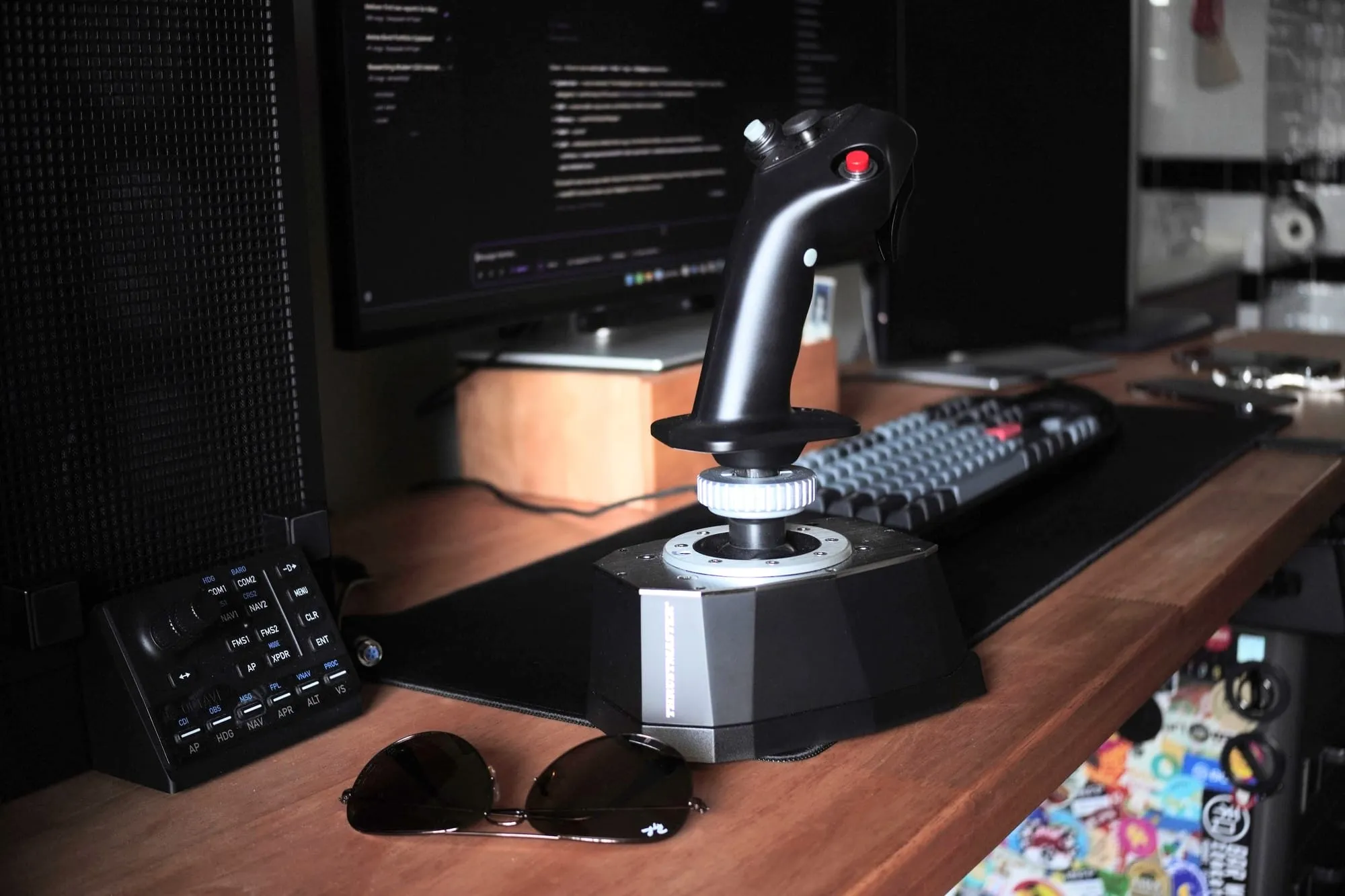
What you should expect in practice: a dumb module — all the feel comes from your base, and all the config software is the base's, not this grip's. Setup is genuinely plug and play. The marketing calls it a captain's left-hand grip yet it works in either hand. And it is larger in hand than any light-aircraft stick I have flown.
Setup and first-use reality
The packaging is the most basic I have seen from a company of this size: thin, lightweight cardboard. There is no realistic risk of damage in transit, but nothing about the box says US$130. Inside, the first thing I noticed was a hex key sitting loose in the box, which made me wonder how many owners have lost it before they ever needed it — it is not mentioned on the box, and it is for the base, not the grip.
Out of the box and in the hand, the first impression is genuinely positive. The grip is comfortable to hold — more comfortable than it looks — in a solid, matte, non-glossy plastic that feels well made. No creaks, no flex, nothing that suggests the price. The only cosmetic tell is the mold seam running along the grip, which the real airliner stick does not have. The buttons are tight with very little give. The hat switch is smooth, like an Xbox controller's. The trigger is the most interesting control: soft on the first stage, then a harder click detent through the second — a two-stage feel you can find blind and use deliberately.
Setup was easy. It mounted, it was recognized, it flew. The one thing worth knowing: the software you might expect to configure is for the base, not the grip. The grip itself has nothing to configure. On the desk it is stable with no wobble at the connector, and the Z-axis lock is a flick switch that locks rock solid with no tools — the VKB Gladiator's twist lock, for comparison, needs a dedicated screw from the spare-parts bag, and VKB's own forums are full of owners who lost it.
I flew it the way I fly everything: left-hand GA in MSFS.
The Magenta Standard evaluation
The five criteria below come from the Magenta Standard evaluation list — mechanics, tactility, integration, procedural value, and ROI.
1. Mechanics: does it mimic real aircraft control travel and resistance? — 4.5/5
A sidestick grip carries no throw or resistance of its own; that all comes from the base. So the honest question here is narrower: what does the grip itself contribute? The answer is three small engineering wins and one compromise.
The Z-axis lock is the standout. A flick of a catch locks the twist solid — no screws, no tools, nothing to lose. If you fly with rudder pedals, you won't need this. The connector is rock solid, with zero wobble at the joint. And the two-stage trigger is exactly what a two-stage trigger should be: a soft first stage for the deliberate action, a harder detent for the committed one.
The compromise is size. Real light-aircraft sticks, like the one on the Diamond DA40, are thin enough to wrap a hand around; this grip is large and fills the palm. It is comfortable (that is not the problem) but comfort comes down to where the base sits on your desk. Get the height right and it disappears into the flying; get it wrong and the size makes itself known. Most GA pilots will be more comfortable with a lighter, thinner stick.
2. Tactility: can you operate it eyes-outside? — 4.5/5
For a sidestick, the test is simple: can you find every control by feel? This grip passes completely. The layout is simple — five buttons, a hat, a trigger, a mini-stick — and every control is within reach without looking down. That simplicity is what makes it work: there is less to hunt for.
The trigger deserves the repeat mention. This one is well done — you can feel the first stage engage and the second detent click without ever taking your eyes outside. The hat switch is smooth rather than clicky, which suits quick glances around the cockpit but would be a weakness if you needed it for precise trim. The mini-stick is the tactile weak point for GA: it is like an Xbox controller's thumb stick, with no distinct clicks, so fine inputs are hard to make deliberately.
And the ambidexterity claim beats the marketing. Thrustmaster sells this as a captain's left-hand grip. It works in both hands, with every control reachable either way. I fly GA left-handed out of habit even though I am right-handed, and I found nothing that favored one hand over the other. The "captain's left-hand" framing undersells a grip that comfortably fits anyone.
3. Integration: how seamlessly does it interface with training software? — 3.5/5
The plug-and-play story is clean: it mounted, was recognized, and flew with no configuration. But this is the review's strangest finding: the more expensive grip is the less compatible one.
It mounts only on Thrustmaster bases — AVA, Sol-R, Warthog MKII, and the original Warthog with a converter that caps you at five buttons and one POV hat. It will not mount on the Virpil WarBRD; the mount does not line up. WinCTRL lists an official TM grip conversion kit for its Orion and Super Libra bases — a modification that opens the grip, not a plug-and-play mount — though its placeholder price leaves real availability unproven, and third-party kits are of unclear fit. There is no free path off a Thrustmaster base: the kits cost extra on top of the US$130 grip. Meanwhile the MOZA MA3X, which I reviewed on the WarBRD in June, uses the standard 5-pin aviation connector and mounts on the WarBRD and the AVA base alike. I tested the MOZA on the AVA base this time, and it worked perfectly. The US$80 grip is the cross-compatible one; the US$130 grip is locked to its own ecosystem.
The software story is thin by design: the grip is a dumb module, and everything configurable belongs to the base. That is consistent with a grip-only product, but it means the grip itself brings no profile depth, no per-grip memory, nothing to tinker with.
4. Procedural: does it support correct muscle memory for syllabus checklists? — 3.5/5
This is the pillar where the audience splits, and the review has to be honest about it.
For the Airbus path, this grip is genuinely good. The 1:1 licensed geometry puts the AP-disconnect button, the trigger, and the thumb controls exactly where the real sidestick puts them. If your training goal is Airbus-type flight deck flows — cadet prep, A320-family procedures — the muscle memory you build here is the point, and the two-stage trigger is a real procedural asset.
For GA, it fails the one test that matters: trim. A typical light-aircraft stick gives you elevator trim on the grip; this one doesn't, and I tried to make the mini-stick do the job. It is too loose, with no detents, and precise trims are hard. I am not training to fly the Airbus, so the exact modeling does not change the equation for me. For the aircraft I train for, eg. the Piper SportCruiser or the Bristell NG5, the left-hand-stick GA world — the MOZA's hat and toggle map to trim naturally, and that is the difference between practicing a habit and fighting the hardware.
The honest score is a split: close to 4.5 for the Airbus-pathway reader, closer to 3 for the GA reader. One number has to go on the card, so it is 3.5 — and this paragraph is why.
5. ROI: does the proficiency gain justify the cost? — 3.5/5
At US$130, the grip alone is 63 percent more than the US$80 MOZA, and it brings a second requirement: a Thrustmaster base. If you do not already own one, the realistic entry price is US$475 — the grip, the AVA base, and the desk plate the manufacturer recommends for desktop use. The MOZA goes on a base you may already own.
What the price buys is the license: an officially Airbus-licensed sidestick grip with 1:1 geometry and the build quality to match. For the Airbus-pathway buyer, that is a defensible premium. For everyone else, it is a premium for authenticity, and the MOZA does the GA job better for less.
The licensing question: what does "officially licensed by Airbus" buy you?
The license is the product's headline, so it deserves a straight answer. What it buys: a 1:1 scale, officially endorsed replica of the real sidestick — exact shape, exact control placement, the Airbus badge on the box. It is also the only officially licensed Airbus sidestick sold as a grip: Thrustmaster's TCA Sidestick, its other licensed Airbus stick, is a complete stick with its own base, and every other grip module in this category is unlicensed. What the license does not buy: any functional advantage. The license does not make the sensors more precise, the plastic sturdier, or the trim problem disappear. It is a fidelity attribute, not a function.
One caveat: what the license actually covers is opaque. Is it the right to use the Airbus brand, the right to reproduce the geometry, or both? Thrustmaster says only that the grip was developed "in official partnership with Airbus," and the legal scope of that partnership is not public. What we can judge is the result: a 1:1 replica that sits in the hand the way the real thing is supposed to.
That makes the training answer simple. If your training pathway is Airbus — if you are building the muscle memory of where the AP disconnect and the trigger live in a real A320 — exact geometry is a training attribute, and the license is the point. If your training is GA, the license is decoration. The layout is Airbus-specific, and GA needs trim, which this grip cannot do well.
Thrustmaster markets one more twist worth noting: with the included module and button cover, the grip transforms from an A300-series airliner configuration into an A400M military transport cockpit "in just a few steps." It is a clever piece of modularity as it widens the audience from airliner simmers to military-transport simmers — a niche within a niche.
Net: the license buys fidelity for the Airbus faithful.
The other option: MOZA MA3X
| Thrustmaster Airbus Add-On Grip | MOZA MA3X | |
|---|---|---|
| Price | US$130 | US$80 (~US$90 shipped to Singapore) |
| License | Official Airbus license | Unlicensed, Airbus-inspired |
| Handedness | Marketed left-hand; fits both hands | Marketed right-hand; fits the left hand by luck |
| Controls | 5 buttons, 4 axes, two-stage trigger, mini-stick, Z-axis with tool-free lock | Trigger, 8-way hat, 3-position toggle (12 signals total) |
| Trim-mappable controls | Mini-stick only — loose, no detents | Hat and toggle — precise, tested |
| Base compatibility | AVA, Sol-R, Warthog MKII only; not WarBRD; WinCTRL via conversion kit | Standard 5-pin aviation connector — WarBRD and AVA base both work |
| Z-axis | Lockable, tool-free | No twist axis |
| Weight | 203 g, matte plastic | ~220 g, composite with glossy piano black ABS |
If you fly Airbus, this grip is the authentic option and the MOZA is a shape that merely suggests one. If you fly GA, the MOZA has the controls that matter and the mounting freedom that the licensed grip does not.
For the tier above, the SimWorkShop S3x (US$350) offers 1:1 geometry in left- and right-hand versions on MOZA and Thrustmaster AVA bases, and the Virpil CDT-AERO-L is a purpose-built civilian left grip US$140 — if you can wait the three months it quoted me.
Who this is for
- Airbus simmers who want the officially licensed captain's-sidestick feel on an AVA, Sol-R, or Warthog MKII base — the license is the point for this buyer
- Anyone training toward Airbus-type flight deck flows, where exact geometry and control placement are part of the training
- A400M and military-transport simmers, via the module swap
- Simmers without rudder pedals who want a real yaw axis — the tool-free Z-lock is the hook
Who should skip
- GA pilots training on DA40, SportCruiser, or Bristell — there is no trim on this grip, the mini-stick cannot fill the gap, and the MOZA is the better left-hand GA buy on controls and compatibility
- Anyone without a Thrustmaster base — the realistic entry price is US$475 with the AVA base and desk plate, and it will not fit a Virpil or WinCTRL base directly
- Original Warthog owners — the converter path caps you at five buttons and one POV hat
- GA pilots who want a thinner, lighter stick in hand — this grip is large by light-aircraft standards