
GoFly Aviation (Sunshine Coast, Australia)
GoFly runs a three-week, all-inclusive RPC pathway at Caloundra Airport on Queensland's Sunshine Coast — purpose-built for Singaporean and Hong Kong students, capped at two at a time, and priced at AU$385/hr with briefings, exams, and landing fees included.
Location: Caloundra Airport, Sunshine Coast, QLD — Class G airspace, two sealed runways, no control tower
Licenses offered: RAAus only — RPC, endorsements (passenger, cross-country), instructor pathways; onward GA training (RPL/PPL) routed via feeder schools
Fleet: 4 x Sling 2 (light sport aircraft)
Dual rate: AU$385/hr (overseas students, all-inclusive — briefings, exams, landing fees included)
Estimated RPC cost: AU$10,780–AU$13,475 (overseas students, 28–35 hours typical at AU$385/hr; domestic range is AU$6,000–AU$8,550)
International students: Yes — dedicated program for Singapore and Hong Kong students
Max concurrent overseas students: 2
Disclosure. Magenta Debrief was not paid to produce this profile. The school had no editorial influence over the verdicts or the text. We contacted GoFly during the review to confirm operational details not published on the website, and after publication to invite factual corrections. One round of corrections from the school has been incorporated.
The school in one paragraph
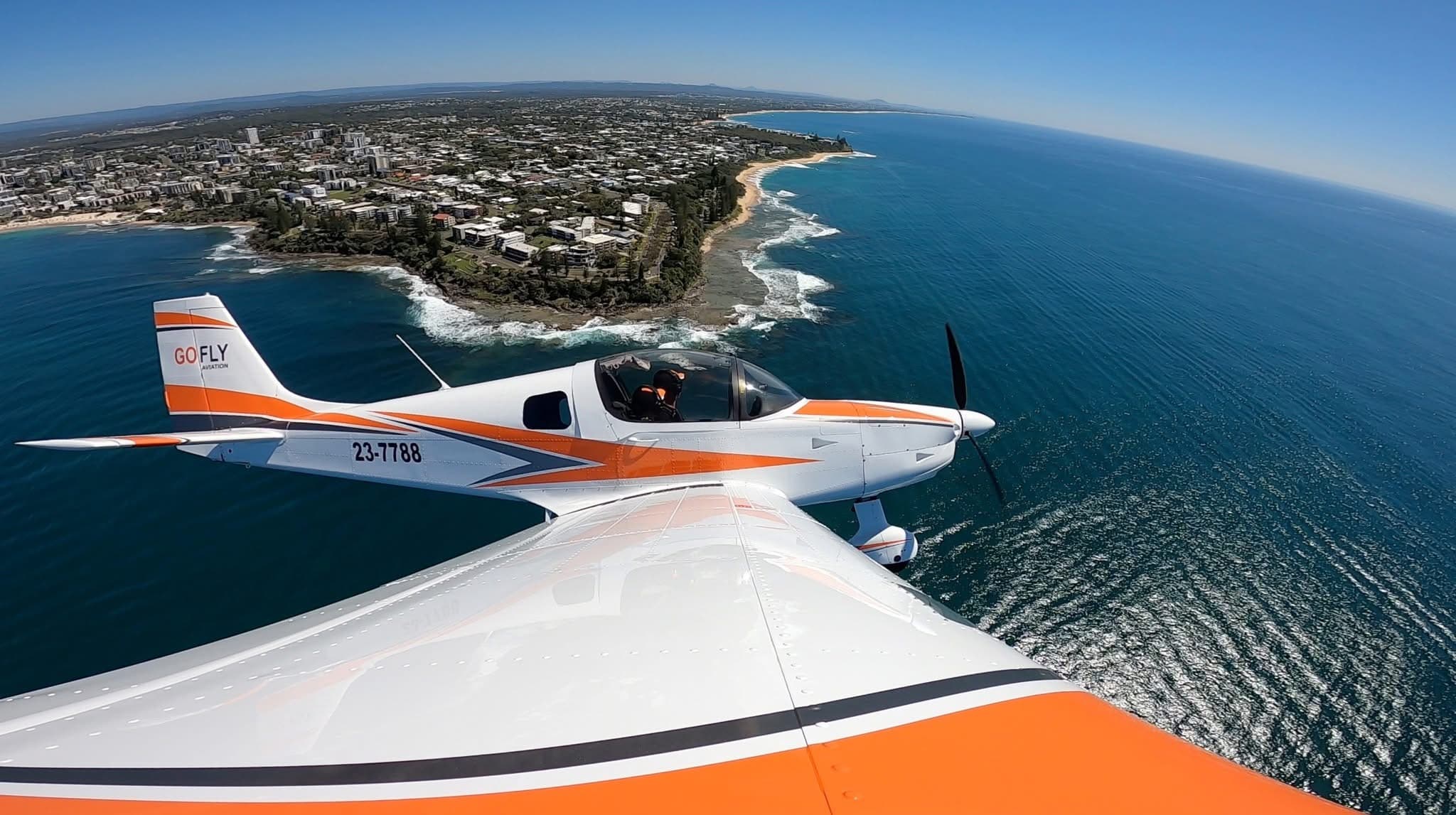
GoFly Aviation is an owner-operated school at Caloundra Airport on Queensland's Sunshine Coast, about 100km north of Brisbane. It has been running for 14 years under Damien and Anne-Maree. Since dropping its GA program on profitability grounds, GoFly focuses exclusively on RAAus training and positions itself as a feeder school into larger GA and airline academies — Sunshine Coast, Caboolture, Wellcamp, and Brisbane — for students continuing to RPL, PPL, or CPL. Caloundra is uncontrolled Class G airspace with two sealed runways and no control tower — no ATC queuing, no waiting for commercial traffic, and the choice of runway means crosswind training happens on demand rather than by chance. The school runs a purpose-built international student program — a 3-week intensive designed specifically for Singaporeans and Hong Kong residents who want to earn their Recreational Pilot Certificate without committing to a full semester. It trains in Sling aircraft, offers all-inclusive pricing, and deliberately caps international student intake at two at a time. It is not a large, factory-style flight school. That is both its limitation and its clearest advantage.
How we assess schools
Magenta Standard profiles evaluate flight schools across five pillars. Each pillar maps to a decision a prospective student is actually making.
- Pathway clarity — whether a student can map the full route from enrollment to license: hour ranges, exams, endorsements, what comes after RPC
- Cost integrity — whether pricing is complete and upfront, with all-in numbers a student can budget against without phoning the school
- Training environment — whether the airport, airspace, fleet, and weather actually support efficient training, or eat into the hours a student is paying for
- Instructor quality — who teaches, what their qualifications are, and how supervision is structured
- Overseas readiness — for schools accepting international students: visa guidance, accommodation, transfers, pre-arrival theory, and cap discipline
One principle sits behind every Magenta Standard profile: we only review schools whose information is publicly available. If a school does not publish its pricing, syllabus, instructor team, or operational policies on its own website, we cannot assess it — and a student doing their own due diligence cannot either. The Standard reads what the school has chosen to make public, then evaluates it on the student's behalf.
This profile is based on a structured review of GoFly's public website and the RAAus directory. No in-person visit.
Pillar 1 — Pathway clarity
Verdict: Strong. GoFly maps the full RPC pathway clearly and publicly. The syllabus follows the RAAus competency framework, hour ranges are stated (20 hours minimum; overseas students typically require 28–35 hours per the school's own guidance), and the five exams are described in sequence. The overseas students page goes further — a sample 3-week schedule is published, showing exactly what two lessons a day, six days a week looks like on the ground. The pathway beyond RPC (nav, passenger endorsements) is described on-site, with onward GA training (RPL, PPL, CPL) routed through GoFly's feeder relationships with larger schools at Sunshine Coast, Caboolture, Wellcamp, and Brisbane.
Pillar 2 — Cost integrity
Verdict: Strong. For overseas students, the rate is AU$385/hr all-inclusive (theory briefings, exams, landing fees). The overseas page states 28–35 hours is typical, putting the total RPC cost at approximately AU$10,780–AU$13,475 — the AU$6,000–AU$8,550 figure on the RPC page is the domestic rate and doesn't apply. RAAus membership (~AU$360/year) is called out separately, accommodation is priced, and a 2-year GoFly Online premium subscription is bundled.
Pillar 3 — Training environment
Verdict: Strong. Caloundra punches above its size. Two sealed runways with no tower and no commercial traffic means lessons start on time, every time — no ATC sequencing, no slot waiting, no holding patterns eating into your AU$385/hr. Instructors can choose the runway to manage or introduce crosswind exposure, a flexibility most single-runway schools simply don't have. The Class G airspace keeps radio workload low, which lets early-stage students focus on flying.
The fleet is four Sling 2s — a modern South African LSA with docile handling, good visibility, and a reliable Rotax engine. The same aircraft appears in GoFly Online's video training materials, so theory and flight are fully aligned. Beyond the aircraft, GoFly's use of in-cockpit video recording is uncommon among the schools we've reviewed — it directly accelerates learning by letting students rehearse and review outside of paid lesson time.
GoFly flies a full day from 7:30am to 5pm and is the only school based at Caloundra — all four Slings can be in the circuit at the same time when bookings warrant, with no competition for runway access from other operators. The subtropical climate is generally favorable — 100+ flyable days per quarter — though the wet season (November to March) carries rain risk, and the school advises building in three weeks to absorb delays.
Pillar 4 — Instructor quality
Verdict: Strong. The team is larger and more structured than the homepage suggests.
The GoFly Team page lists a full team of 10+ named staff. Damien Wills is formally listed as Chief Flying Instructor (CFI) and examiner — not just owner. He holds full RAAus testing approval, meaning students can complete their flight test at the school.
Individual bios are published on the GoFly Team page — each name is clickable and opens a per-instructor profile. Students are assigned the same instructor across each 5-day block, with instructors working five days on and two days off.
Pillar 5 — Overseas readiness
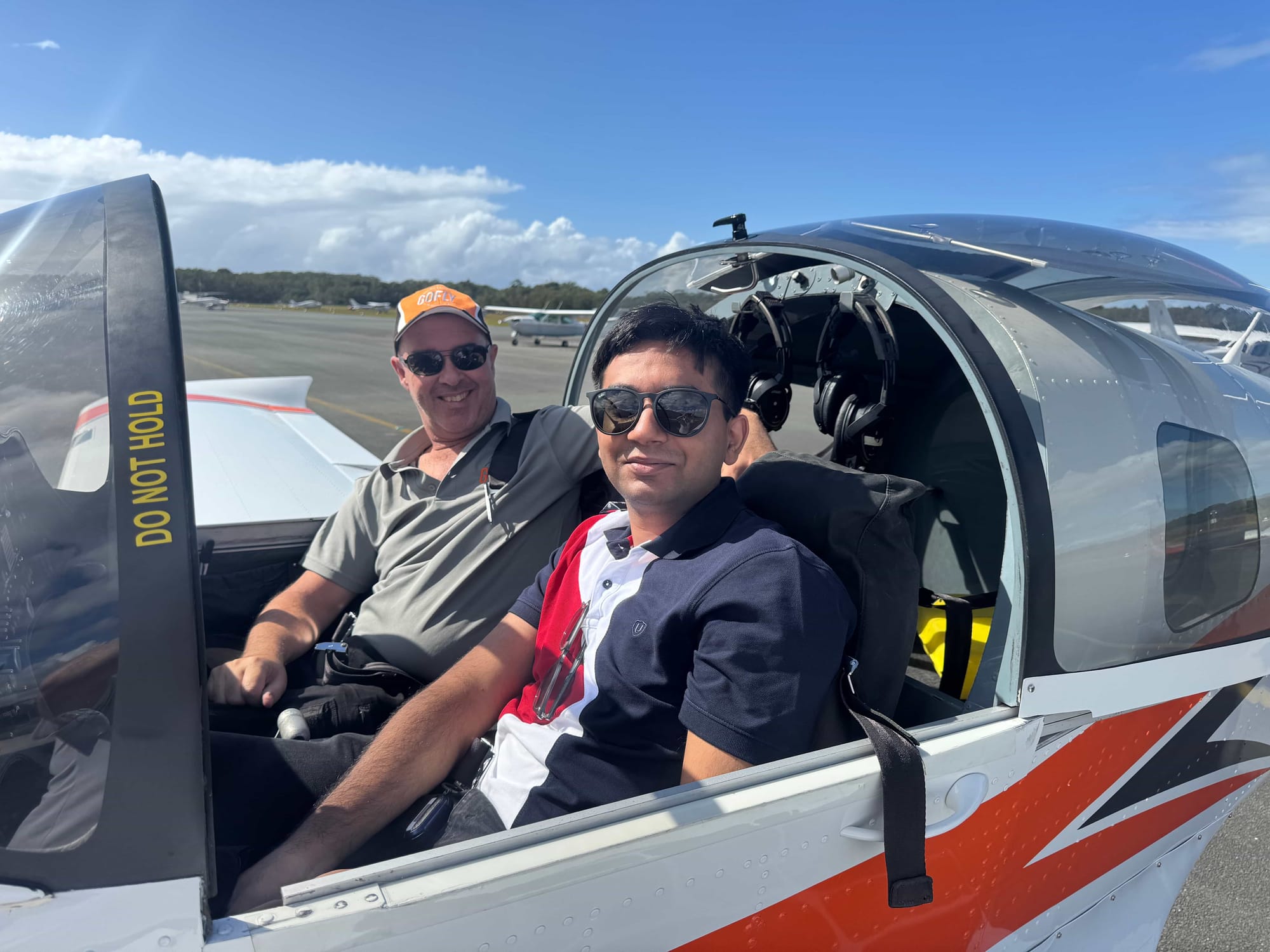
Verdict: Strong. GoFly runs a dedicated overseas students program — uncommon in the RAAus network. Visa type is specified correctly (tourist subclass 600, 601, or 651), accommodation is named and priced, airport transfers are detailed, and a sample 3-week schedule is published down to the daily structure. These are not marketing gestures but the decisions a school makes after it has actually put students through the process.
According to the school, GoFly has trained around 40 students from Singapore and Hong Kong over eight years, with 16 students planned for the next intake (10 confirmed at time of writing). Anne-Maree, who runs operations and marketing alongside Damien, recently overhauled the international students page and is actively running paid acquisition — meaning the program is operationally live, not a passive listing.
Pre-arrival, students get access to GoFly Online — a theory platform with 360-degree video briefings, practice exams, and an aviation dictionary. Notably, the platform is openly accessible to any student, not just GoFly trainees. Students who arrive having already worked through the syllabus consistently move faster. The cap of two concurrent international students reinforces this: you are not competing for instructor time with a cohort.
Not all students train to RPC. A named alternative pathway is 10–12 hours of training to strengthen a Cathay Pacific cadetship application — a structured use of the school as a stepping stone rather than a destination. GoFly handles both paths. The most recent documented result — Gary from Singapore, RPC in 2.5 weeks in 2024 — is the kind of current, specific data point that matters.
The Magenta take
GoFly's overseas program is the real thing. The pricing is upfront, the visa guidance is specific, the schedule is structured, and the accommodation is named and priced. These are things a school does when it has actually put Singaporean and Hong Kong students through the program — not when it has merely decided to add an "international" page to its website.
The training environment at Caloundra is a genuine advantage. Two sealed runways with no tower and no commercial traffic means your AU$385/hr buys more air time than the same rate at a busier airport. The Sling 2 is an excellent primary trainer. The GoFly Online platform — with 360-degree video lessons and a structured syllabus that mirrors the in-aircraft training — is more developed than what we've seen at other RAAus schools.
Who should train here
- Singaporeans and Hong Kong residents planning a 3-week RPC trip with a fixed budget
- Students targeting a first-solo milestone as a stepping stone to commercial aviation (e.g., Cathay Pacific applications)
- Students who want all-inclusive pricing and no hidden costs
- Anyone who values small class sizes and personal attention over large-school infrastructure
- Students who want modern aircraft (Sling 2) with a strong supplementary theory system
- Pilots who want to train efficiently — two runways, no tower, minimal delays
Who should look elsewhere
- Students planning a direct CPL pathway who need controlled airspace (Class D/C) experience early
- Students wanting RPL, PPL, or CPL completion at a single school — GoFly is RAAus-only, with onward GA training routed via feeder relationships
- Anyone who cannot manage the 2-student cap (booking lead time may be significant)
- Students who want to combine training with a major city experience — Caloundra is scenic but small
How to contact
Contact: Anne-Maree (Co-operator, Operations & Marketing) and Damien (CFI)
Email (preferred): goflyaviation@gmail.com
Phone: +61 7 5341 8125 (admin hours: 9am–1pm, Mon–Sun)
Overseas students page: goflyaviation.com.au/overseas-students
