
Virpil VPC R1-Falcon review: exceptional hardware, wrong geometry for GA training.
The R1-Falcon is one of the best-built sim rudder pedals available — precise sensor, all-metal construction, thoughtful customization. For combat sim and DCS, the hardware earns its price. For GA training, its pedal geometry has a procedural fidelity problem worth understanding before you buy.
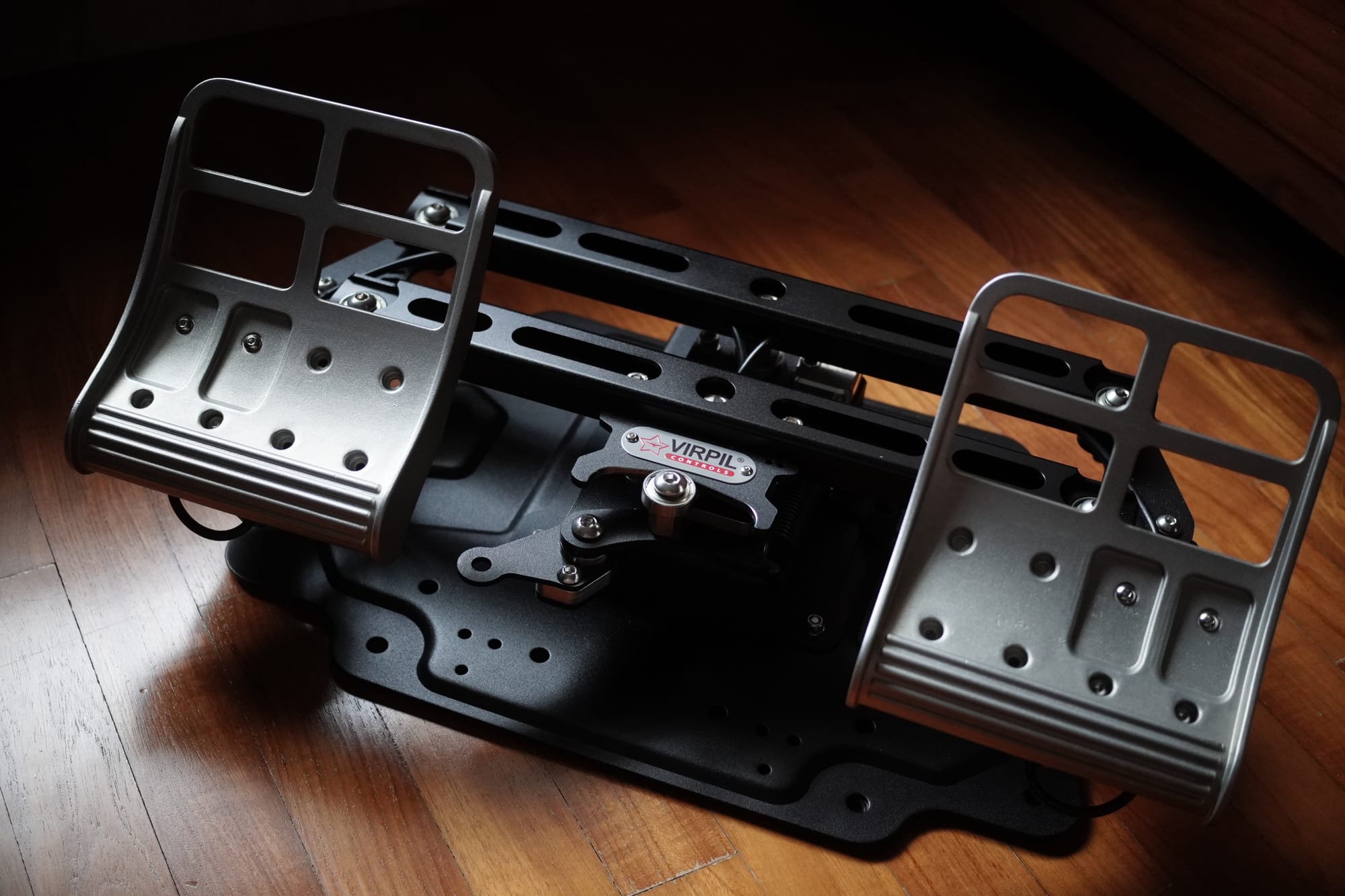
The Virpil VPC R1-Falcon arrives in a box that makes you second-guess your delivery address. It's enormous. The unit inside weighs enough that pulling it out requires two hands and a moment of genuine effort. Before you've plugged anything in, the R1-Falcon has already made its case: this is a serious piece of hardware.
At around US$350 before shipping, it competes at the top of the consumer sim rudder market. The question worth asking — especially if you're using sim time to train for real GA flying — is whether that premium is pointed in the right direction.
Virpil sent this unit over from Lithuania — a small reminder that the best sim gear often comes from unexpected corners of the map. The company started in 2016 as a community project, founded by flight sim enthusiasts from the DCS and IL-2 forums who were dissatisfied with what was available. They've since built out a dedicated production facility with in-house CNC machining, PCB production, and over 60 staff.
About this review
Virpil provided this unit for review at no cost and with no editorial conditions. There are no affiliate links in this piece. Virpil did not see a draft before publication. The unit will be retained for future comparisons.
What this is
The R1-Falcon was introduced in March 2025. It is a 3-axis, all-metal rudder pedal designed as a half-foot, modern combat-style pedal. The footplate covers the front half of the foot.
Specifications
- Construction: All-metal, CNC-machined throughout
- Sensor: VPC 14-bit contactless digital, 0.02° accuracy
- Axes: 3 (yaw + left/right differential toe brakes)
- Pedal style: Half-foot, modern combat aluminium
- Cams (included): Soft center (pre-installed), hard center, free center
- Springs (included): Heavy (pre-installed), standard
- Spring tension: Infinitely adjustable via twist dial
- Pedal angle range: 20°
- Pedal spacing: Adjustable
- Pedal tilt: Adjustable
- Connectivity: USB + AUX (proprietary XS9 Aviation daisy-chain interconnect)
- Warranty: 2 years
- Price: €299.95 (~US$350 excl. shipping)
This is what you should expect in practice:
- Light assembly required; no printed instructions — documentation lives online
- Plug-and-play USB recognition across major sims
- Exceptional sensor precision with a distinct, reassuring center
- Heavy, stable floor presence without any additional mounting
- Proprietary cable; replacements require ordering from Lithuania
Out of the box
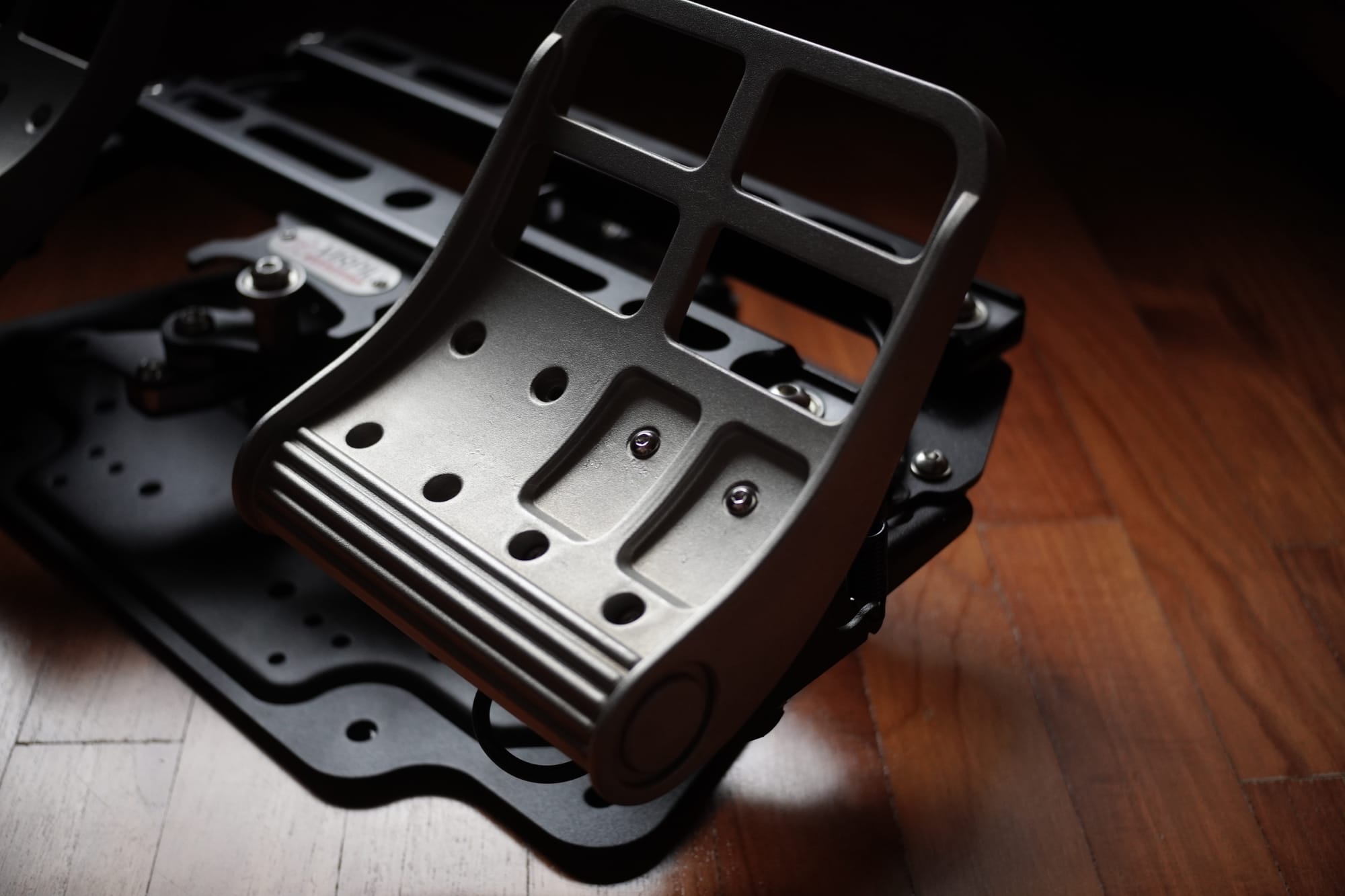
The construction is all-metal, CNC-machined throughout. There are no 3D-printed structural parts anywhere on this unit. Everything you touch is metal. The R1-Falcon has no flex. None.
Six rubber feet anchor the base to the floor. Combined with the unit's 8 kg weight, it stays put during aggressive rudder inputs without any additional mounting. The rubber pads are the one concession to the ordinary — they're not particularly grippy, but given the weight of this thing, it anchors itself nicely on my parquet floor.
The attention to detail in the small things is genuinely impressive. Rubber covers protect the USB port and auxiliary connector sockets. Each cover is tethered to the unit — a small design choice that signals how much thought went into this. You will not lose them.
Setup and first-use reality
Some light assembly is required out of the box: attaching the pedals to the base, choosing your cam profile, setting spring tension. None of this is technically difficult. But there are no printed instructions in the box. Virpil's documentation lives online, and first-time users will spend time searching for the setup guide before they find their footing (pun intended).
No tools are included either. Assembly requires multiple hex keys (H2.5, H4) and a wrench — none of which are in the box. At this price, a basic tool kit tucked inside would have been the right call.
The 2-meter Virpil USB cable that connects to the PC is a proprietary multi‑pin XS9 Aviation interconnect that carries both low‑voltage DC power and serial communication signals, enabling daisy‑chain linking of Virpil devices without each needing its own USB connection. The lock collar is nice, but be aware, if you'll have to order another cable from Lithuania if you were to damage this (about US$14 excluding shipping).
One note on Virpil’s configuration software: it’s ugly in the way most peripheral vendor software is ugly — cluttered, confusing, and clearly designed by engineers rather than a UI/UX designer. That’s a shame, because the underlying hardware is doing a lot. The good news is you don’t need to live in the app. In my case: launch → plug in USB → immediate firmware update prompt (about a minute) → calibration (under a minute, across all three axes). After that, you can basically forget it exists.
Where training friction shows up (and why it matters)
Three cam profiles ship in the box: soft center (pre-installed), hard center, and free center. Two spring weights are included: heavy (pre-installed) and standard. Spring tension is adjustable via a twist dial on the unit — no tools, no disassembly. Pedal stance width is also adjustable, letting you move the pedals inward or outward to fit your seating position or cockpit geometry.
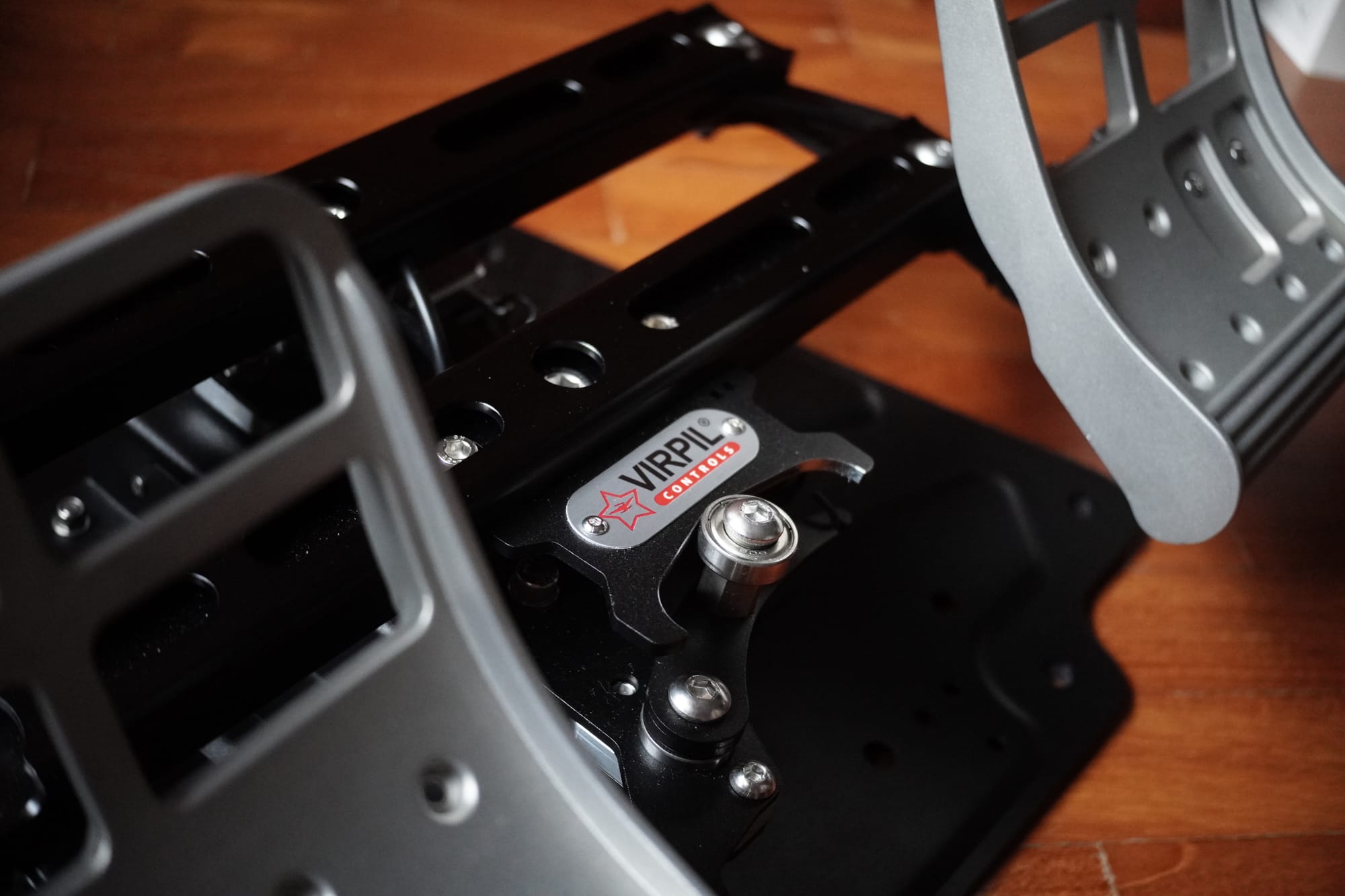
One optional upgrade worth flagging: Virpil sells a damper kit for the R1 series (approximately US$47), which reduces spring bounce on return to center and can be configured to hold the pedals in place.
The 14-bit VPC contactless sensor resolves to 0.02° of movement. In DCS and other demanding sims, the pedal feel is described universally as precise, with a distinct and reassuring center. Braking feel is good.
For combat sim and helicopter pilots, this configuration is close to ideal. But that's not our use case in GA training.
The Magenta Standard evaluation
Every piece of hardware reviewed by Magenta is audited against five pillars to ensure it functions as a procedural training device, not desk decoration. The point is not immersion. We are looking for transfer.
The Magenta Standard Evaluation
Every piece of hardware reviewed is evaluated against five professional criteria to ensure it serves as a true procedural training device.
| Criteria | Evaluation Logic |
|---|---|
| 01 Mechanics | Does the hardware mimic the physical forces and control travel found in real General Aviation aircraft? |
| 02 Tactility | Does it support eyes-outside operation through distinct physical feedback and ergonomic positioning? |
| 03 Integration | How seamlessly does the device interface with Electronic Flight Bags (EFB) and professional training software? |
| 04 Procedural | Does the hardware support the muscle memory needed for actual syllabus requirements and cockpit checklists? |
| 05 ROI | Does the measurable gain in proficiency justify the hardware cost compared to wet-hire aircraft rental hours? |
WANT TO DIVE DEEPER? VIEW THE MAGENTA STANDARD →
1. Mechanics: does it mimic real aircraft control travel and resistance?
Verdict: Exceptional sensor precision; half-foot combat design conflicts with GA rudder geometry
Here is where the R1-Falcon's design philosophy and GA training requirements diverge.
Virpil describes the R1-Falcon explicitly as a "half-foot, modern combat style" pedal. The footplate covers the front half of the foot. That design choice is intentional and well-suited to combat sim — shorter pedal travel, faster deflection, optimised for the kind of aggressive rudder inputs you'd make in a fighter aircraft. In a GA cockpit, none of those priorities apply.
In a real aircraft — a Cessna 172, a Piper, a DA40 — the standard rudder technique places heels on the floor and the balls of the feet on the pedals. The heel acts as a pivot point. You push forward with the ball of the foot while the heel stays anchored. This geometry gives you modulated, progressive control of both rudder and brake as separate, distinct inputs.
The separation matters. In GA aircraft with differential toe brakes, the brake surface is the upper portion of the pedal. With your heel on the floor, pushing the pedal deflects the rudder. Only tipping your toes upward engages the brake. Heel contact keeps those two inputs physically distinct. When the heel floats, the distinction collapses — rudder pressure bleeds into brake pressure, and you lose the proprioceptive reference that tells you how much deflection you've applied.
The R1-Falcon's pedal geometry makes heel-on-floor contact possible, but uncomfortable. The pedal angle and height work against it. The unit includes an adjustable tilt mechanism — and adjusting it does help. After spending time with the tilt dialled in, heel contact became more achievable and the overall position noticeably more manageable.
But it did not fully resolve the geometry problem on a standard desk setup. The improvement is real; it is not a fix. Users on dedicated sim rigs with lower seat positions — closer to actual cockpit geometry — will get better results. Office chair users (like me) with a higher seat and steeper leg angle will still find the position compromised even with the tilt adjusted. The effect varies with shoe size and seating setup, and is worth testing before drawing a conclusion.
But the baseline condition, straight out of the box on a typical desk setup, pushes you toward a heel-up position. For GA training purposes, that's a procedural fidelity problem.
One option worth noting: Virpil sells the R1-Legend Footplates as a separate US$60 purchase, which swap onto the R1-Falcon base. The Legend uses a full-foot design — a different geometry.
Magenta Debrief Flight Sim Reviews
Get the latest hardware and software reviews delivered to your inbox.
2. Tactility: can you operate it eyes-outside?
Verdict: Yes — the center feel and sensor precision are good enough that you stop managing your feet
Rudder pedals are operated by feel by definition — there are no labels to read, no shift modes to track. The distinct center detent and linear travel mean pedal position is always clear. After a few sessions, yaw corrections become automatic rather than deliberate — you are flying, not managing hardware.
3. Operational integration: does it fit real pilot workflows and real desks?
Verdict: Strong hardware integration; wait time is real and unpredictable — plan accordingly
Integration for rudder pedals is simple: do they go where your feet go, and do they stay there?
The R1-Falcon's footprint is larger than most competitors, which means placement under a typical desk requires some deliberate positioning. More importantly, it does not move. The unit's mass means it stays put under aggressive rudder inputs. Session-to-session repeatability is strong. You place it once, and it is in the same position every time you sit down.
- Fits under standard desk clearances, though the larger footprint requires some placement thought
- Rubber base pads hold position on hard floors — including parquet — under normal use
- Cable exits cleanly from the unit and does not restrict placement
- Adjustable pedal spacing and angle mean the geometry can be dialled to your seating position
By the way, Virpil's availability varies. Some users have reported 3-5 months of waiting; Virpil says lead time is now about 4 weeks. So check current stock before ordering. If you need pedals on a schedule to complete your set up, factor this in.
4. Procedural value: does it make you better at flying?
Verdict: High risk of ingraining the wrong motor pattern for GA students on a standard desk
Heels-on-floor is a checklist item in GA operations, not a stylistic preference. For tailwheel aircraft and high-performance tricycle-gear planes, the pre-takeoff and landing checks explicitly call for heels on the floor — because inadvertent brake application during the takeoff roll or landing rollout is a genuine safety hazard. GA aircraft have no antiskid, no touchdown protection, no auto-brakes. Pressure on the toe brake at the wrong moment can cause a runway excursion, a blown tire, or a ground loop in a taildragger.
GA pilots are trained to keep heels-on-floor until you actually need to brake for a reason. For sim training aimed at building GA muscle memory, hardware that structurally discourages heel-on-floor contact is working against the goal. Fifty hours of practice on the wrong motor pattern does not transfer cleanly into the actual aircraft.
One nuance worth noting: aircraft with castering nosewheels — Cirrus, Diamond, Van's RV series — require differential braking for directional control at the start of the takeoff roll, before rudder authority builds. The standard instruction is heels on the floor after the first hundred feet or so, once the rudder becomes effective. This doesn't change the overall principle, but it does mean the rule has a brief exception at the very beginning of the roll in castering-nosewheel aircraft.
5. Price: is the ROI real?
Verdict: Worth it for combat sim; for GA training, the investment requires closer examination against purpose-built GA options
Against the WinWing Orion — Virpil's closest current competitor — my preference leans clearly toward Virpil. The Orion is WinWing's first rudder product, and skepticism about after-sales support is a recurring theme. Virpil's support is consistently described as best-in-class. The Orion also runs wider in stance, which some users find awkward. The all-metal construction and sensor quality of the R1-Falcon are seen as decisive advantages.
Against the MFG Crosswind — the longstanding precision GA pedal option — the comparison is more interesting. MFG sells a Cessna 172 replica configuration: a universal base paired with footrests modeled directly on the actual C172 pedal geometry. The company describes it as "designed from original aircraft rudders with only minor difference in size." At around US$348 for the bundle, it's positioned at a similar price to the R1-Falcon. For pilots specifically training for GA, that GA-specific footrest geometry is the Crosswind's most relevant feature — and it's one the R1-Falcon doesn't offer by default. The R1-Falcon's closest equivalent is the separate R1-Legend Footplates at an additional US$60.
At the entry end of the market, the VKBsim T-Rudder Mk.V remains a relevant reference point — a significantly cheaper pedal that handles basic GA technique reasonably well but lacks toe brakes — a potential deal breaker for flight training.
Verdict
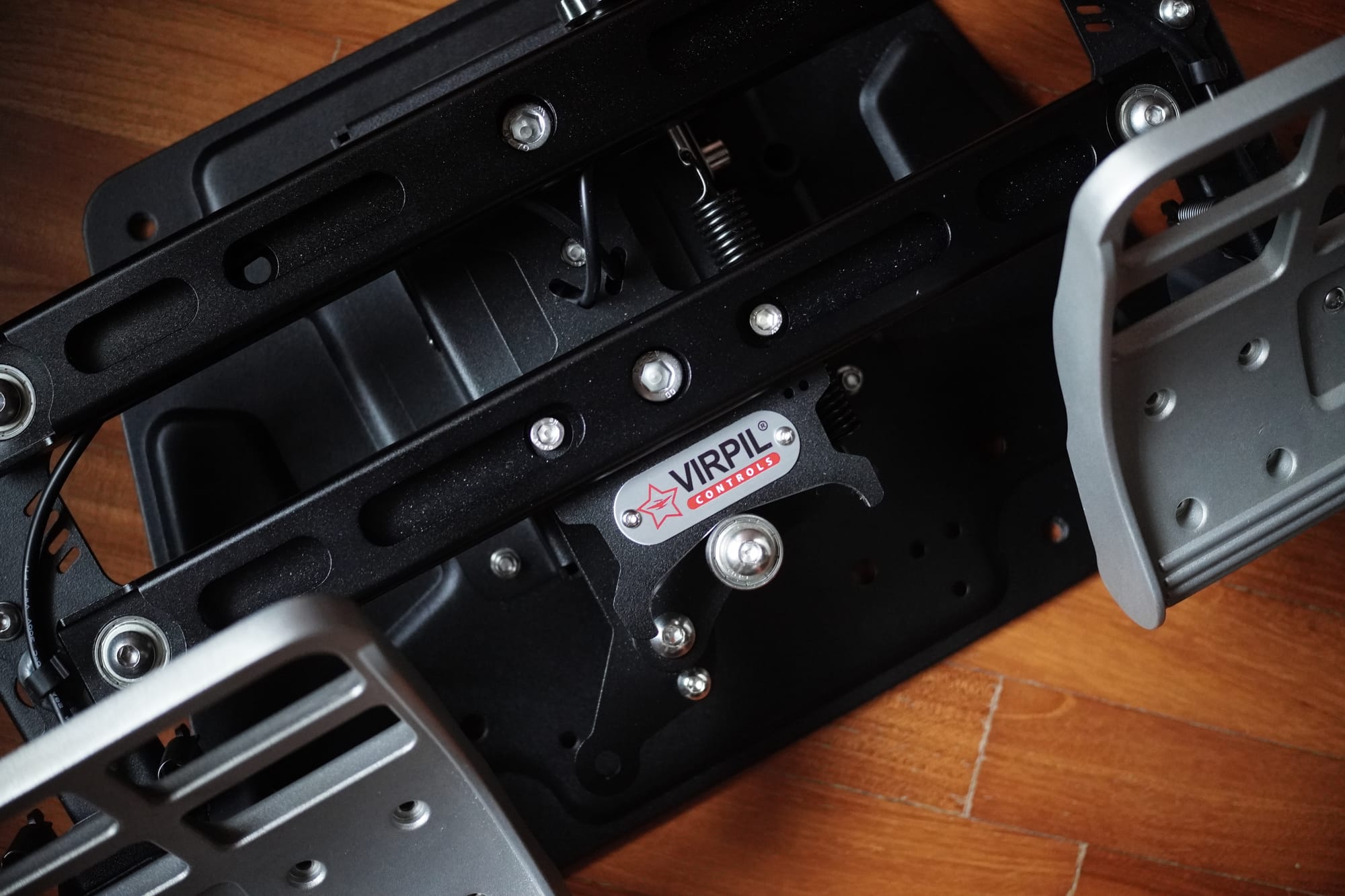
The R1-Falcon is one of the best-built sim rudder pedals available. The sensor precision, material quality, and customization range are genuinely impressive, and for combat sim, DCS, or helicopter operations, the hardware is close to ideal.
For GA training, the geometry creates a real friction point. The heel-on-floor technique — standard in GA, called out in checklists, confirmed in every flight training manual — is structurally discouraged by the R1-Falcon's pedal design in a typical desktop setup. That's not a minor ergonomic note. For a student building procedural habits that need to transfer directly into a real aircraft, it's a meaningful limitation.
If you're flying DCS or building hours in a combat sim: this hardware earns its price. If you're using sim time to build GA training habits: the R1-Falcon is an exceptional piece of engineering aimed at a different problem.
Who should buy it
- Combat sim pilots, DCS players, and helicopter simmers who want the best-built pedals available at this price point
- GA simmers on a dedicated rig with a lower seat position, where heel-on-floor contact is achievable and the geometry can be made to work
Who should skip it
- GA students on a standard desk setup where procedural fidelity needs to transfer directly to a real aircraft
- Anyone for whom the heel-on-floor technique is a hard training requirement and rig geometry cannot be adjusted to compensate